 Australia's GDP growth slowed in the fourth quarter, and retail sales grew less than expected, but investors are optimistic because of the statement by Reserve Bank Chairman Philip Lowe that the next change in rates will be more, and not less, as the economy moves in the right direction. This, in particular, indicates that the growth in spending in non-extractive industries is now the largest since the financial crisis. Nevertheless, for the time being, the central bank adheres to a neutral position. This week, the focus will be the speeches of RBA officials Michelle Bullock, Christopher Kent and Guy Debell. From a technical point of view, higher highs and lows indicate further strengthening of AUD/USD, which should reach at least 0.79.
Showing posts with label AUD/USD. Show all posts
Showing posts with label AUD/USD. Show all posts
Monday, 12 March 2018
AUD/USD forecast for the week ahead
Australia's GDP growth slowed in the fourth quarter, and retail sales grew less than expected, but investors are optimistic because of the statement by Reserve Bank Chairman Philip Lowe that the next change in rates will be more, and not less, as the economy moves in the right direction. This, in particular, indicates that the growth in spending in non-extractive industries is now the largest since the financial crisis. Nevertheless, for the time being, the central bank adheres to a neutral position. This week, the focus will be the speeches of RBA officials Michelle Bullock, Christopher Kent and Guy Debell. From a technical point of view, higher highs and lows indicate further strengthening of AUD/USD, which should reach at least 0.79.
Wednesday, 8 November 2017
The Australian Bank kept interest rates, sent the Australian dollar down
 The Australian Central Bank kept interest rates at a record low for the 14th time.
However, this may soon change, given the central bank's forecast for a 3% growth over the next few years and a fall in unemployment from its current levels at 5.5%.
Far more cautious, however, was the tone of the central bank in terms of consumption and inflation.
For the last time, the Australian bank lowered interest rates in August 2016 in order to protect itself against the risk of deflation. The Bank is still facing serious difficulties in returning consumer price growth back to levels of 2-3%.
Inflation rose to only 1.8% in the third quarter of the year, but even this looks pretty high in the short term.
According to the Australian Bureau of Statistics (ABS), built-in inflation is actually about 1.6%.
The futures market does not expect an increase in interest rates in Australia until early 2019. All of this reflects extremely negatively on the Australian dollar, which dropped to 0.7636 against the US or its lowest value since the beginning of July.
Thursday, 26 October 2017
Inflation in Australia below expectations - the Australian dollar with a five-month minimum
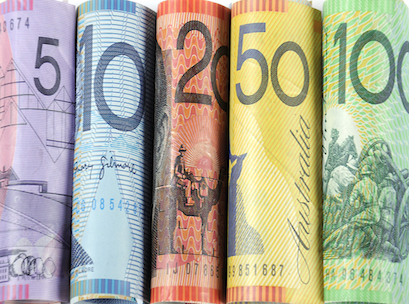 Inflation in Australia was surprisingly low, continuing to be under the central bank's target for a second consecutive year. This is increasingly casting off the prospects of raising interest rates.
Consumer price inflation in the country rose to 1.8% for the year to September, below analysts' average inflation expectations of 2%.
The local currency fell to four and a half months minimum and early in the morning lost 0.6% of its value and exchanged at levels of 0.7721 US dollars.
This is the seventh consecutive quarter in which inflation is below market expectations of 2%.
The Australian central bank's long-term inflation target is between 2% and 3%. Permanently low inflation may, however, change the expectation of a recent increase in interest rates by the central financial institution.
Currently, interest rates in Australia are at a record low of 1.5%.
Thursday, 12 January 2017
AUD/USD
 Against the backdrop of the weakening of the US dollar and the strengthening of the Australian currency, the pair's quotes manage to show an upward trend fourth trading day in a row. But with such a powerful strengthening quotes managed to approach to a very important resistance level of 0.7515/25.
It is noteworthy that this level is not only a maximum of 13 and 14 December, and a minimum of November 11-15. All this indicates a high degree of importance of the marked level of resistance. Accordingly, the risk of corrective decline remains high.
The nearest support level stands at a mark of 0.7455, a break of which would open the way to 0.7430. However, more important still will the support area of 0.7350-0.7370. Until the return of the pair's quotes below the marked area of support, the overall mood remains "Bullish".
Friday, 25 November 2016
Thanksgiving and Black Friday
 Yesterday the United States celebrated Thanksgiving Day and started buying at discount. US financial markets were closed and trading activity has declined markedly, but with the opening of the last trading session of the week in Asia, the dollar came under selling pressure. And everything indicates that this correction can turn into a more active sales in the medium term with a subsequent entry in sideways channel at the current highs.
After the upgrade by the US dollar index highs in the 102nd figure sellers activity increased. Of course, we can talk about fixing profits on long positions, but the fundamental reasons for further growth is not enough. At the same time reports on the change in the balance of foreign trade will be released today. Traditionally, this indicator is in the negative zone, but an increase in the deficit is very negative for the US dollar, especially given its strengthening these days. The experts forecast increase in the deficit to 59.2 billion. The excess of the projected growth rate may enhance the activity of the sellers, but surprisingly good values in the report yet can strengthen the US dollar.
Accordingly, the further strengthening of the EUR/USD, AUD/USD and a weakening USD/JPY is a part of the terms of the basic scenario. But currently there are no strong trading signals to open positions on these instruments.
Wednesday, 7 September 2016
Small currencies rose against the Big Three
 The lack of clarity in relation to the US dollar has left the currency market in domination of small currencies, which are strengthening against the "Big Three" against the background of extreme carelessness of investors in the asset markets, keen on hunting for higher incomes.
On Tuesday the States have returned to work after Labor Day, officially completing the summer holidays on the markets. Together with the autumn in the global asset markets, as a rule, return volatility, in fact, historically, the worst misfortune is happening in September and October. This is an important fact, since the last few weeks on foreign exchange markets reigns criminal carelessness and investors stubbornly refuse to notice the impending danger, considering that central banks will take care of everything, so they can easily search for the most profitable ways to invest.
Only this way could be explained, for example, the strengthening of AUD/USD after yesterday's meeting of the Reserve Bank of Australia, which is the last for Glenn Stevens, who this month leaves the post of chairman and delegates it to Philip Lowe. In the accompanying statement, the RBA noted low inflation and suggested that in the near future the price situation will not change, because the low salaries do not contribute to inflationary pressures.
Tuesday, 12 July 2016
USD reduces losses in inactive trading
 The dollar stopped falling against other major currencies in quiet trading on Tuesday, as investors continue to focus on the upcoming meetings of the central bank on a background of high expectations of additional stimulus.
GBP/USD rose by 1.47% to 1.3182, rebounding from a 31-year low of 1.2794, reached last Wednesday.
Also on Tuesday, the International Monetary Fund said that Brexit likely to have a "negligible" impact on US economic growth.
USD/JPY rose by 1.66% to 104.49, the highest value since June 24, while USD/CHF rose 0.20% to 0.9848.
The yen weakened after the ruling coalition of Prime Minister Shinzo Abe won a landslide victory in elections on Sunday.
Coalition victory strengthened hopes for fresh stimulus measures.
EUR/USD rose by 0.26% to 1,1870.
Australian and New Zealand dollars rose sharply, AUD/USD rose by 1.31% to 0.7633 and NZD/USD rose 0.97% to 0.7289.
Earlier, the National Bank of Australia said that the index of confidence in the business community rose to 6 in June from 3 the previous month.
USD/CAD fell 0.63% to 1.3036, reaching the highest level since June 28.
Commodity currencies also rose, as on Tuesday, oil prices rose after the Organization of Petroleum Exporting Countries said that in 2017 global oil demand will increase, and excess reserves decrease.
USD index showing the US dollar against a basket of major currencies, was down 0.20% to 96.40, rebounding from the low of the day 96.08.
Tuesday, 5 July 2016
AUD/USD - long position from 0.7459
BASIC PARAMETERS
• Price: 0.7459 (market)
• Stop: 0.7400
• Limit: 0.7630
• Expected time for reaching the target: 3 days
The decision of the Reserve Bank of Australia left its main interest rate unchanged at 1.75%, failed to support the Aussie for a long term. The pair is currently trading below the psychological level of 0.7500. Given the negative data expected overseas, I see an opportunity to open a long position in AUD/USD with shallow stop on 0.7400. On hourly chart RSI suggests an impending upward movement. The limit of today's commercial idea is under the maximum from June 23 - 0.7630.


• Price: 0.7459 (market)
• Stop: 0.7400
• Limit: 0.7630
• Expected time for reaching the target: 3 days
The decision of the Reserve Bank of Australia left its main interest rate unchanged at 1.75%, failed to support the Aussie for a long term. The pair is currently trading below the psychological level of 0.7500. Given the negative data expected overseas, I see an opportunity to open a long position in AUD/USD with shallow stop on 0.7400. On hourly chart RSI suggests an impending upward movement. The limit of today's commercial idea is under the maximum from June 23 - 0.7630.


Monday, 6 June 2016
Australian dollar has received support
Since the beginning of the last week AUD was showing sensitivity to Australian statistics - we could sense market uncertainty about the future of monetary policy on the continent. So the Building Approvals index, which came out better than expected - 3.0% (vs. forecasts for -3.1%) led to the growth of the Australian dollar by 25 points.
The growth of the economy for the first quarter also supported the Australian dollar, data came out higher than expected: 1.1% compared with 0.8% forecast. Data registered record high.
If we take an annualized basis, the Australian economy has added 3.1% compared to expectations of 2.8%. Exports rose by 4.4%, which added 1% to GDP growth.
Such indicators may affect the RBA in their future plans of easing monetary policy through lower interest rates.
Reverse effect on the Australian dollar may have only USD with its labor market data, released on Friday.

The growth of the economy for the first quarter also supported the Australian dollar, data came out higher than expected: 1.1% compared with 0.8% forecast. Data registered record high.
If we take an annualized basis, the Australian economy has added 3.1% compared to expectations of 2.8%. Exports rose by 4.4%, which added 1% to GDP growth.
Such indicators may affect the RBA in their future plans of easing monetary policy through lower interest rates.
Reverse effect on the Australian dollar may have only USD with its labor market data, released on Friday.

Subscribe to:
Posts (Atom)